
Fogged-up glasses. A bathroom mirror after a hot shower. A windshield on a humid morning. In each case, the same basic phenomenon is responsible: tiny droplets of water form on a surface and make it difficult to see through.
The problem is more than an inconvenience. Fogging can interfere with cameras, sensors, eyewear, windshields, and other optical surfaces where maintaining a clear view is important. In food packaging, condensation can also drip onto the food and contribute to faster spoilage.
Anti-fog surfaces often take one of two approaches: hydrophilic surfaces encourage water to spread, whereas hydrophobic surfaces encourage droplets to bead up and leave the surface. Nanopatterns can dramatically affect fogging, since they can affect how water interacts a surface as shown in Figure 1.
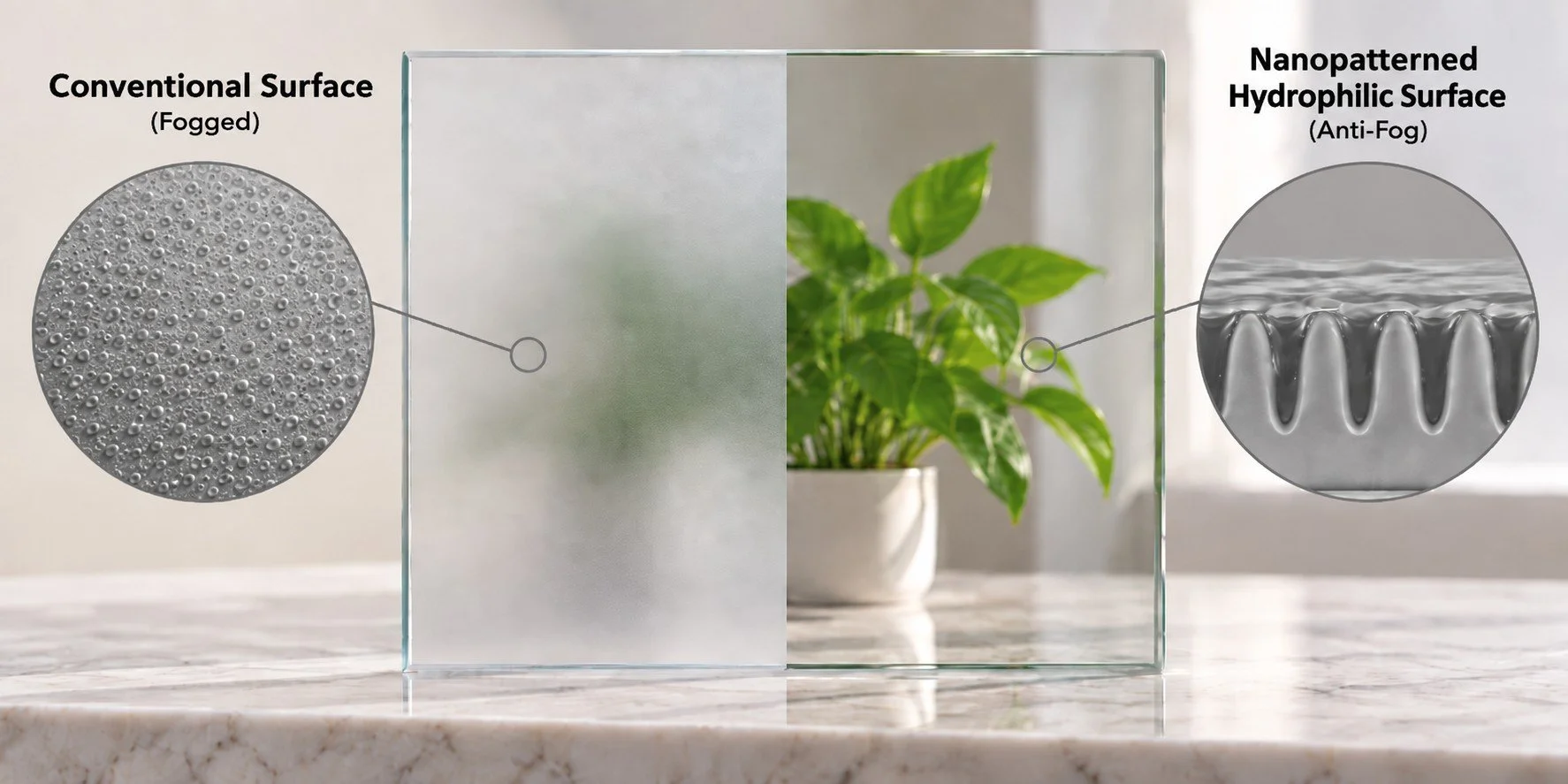
Figure 1: Fog is made up of thousands of tiny water droplets that scatter light. Nanopatterned hydrophilic surfaces can encourage water to spread smoothly, preventing light scattering.
Why Do Surfaces Fog?
Air contains water vapor. When warm, humid air comes into contact with a cool surface, some of that vapor can condense into liquid water. On a conventional glass or plastic surface, the condensed water forms thousands of microscopic droplets that scatter light and give rise to a hazy appearance (Figure 2A).
There are two main ways to address this problem.
On a hydrophilic, or water-loving, surface, condensed water spreads out instead of remaining as individual droplets (Figure 2B). If the surface is sufficiently hydrophilic, the droplets merge into a thin continuous layer of water that scatters light less.
A superhydrophobic surface takes the opposite approach. Water remains in droplets, but those droplets interact only weakly with the surface (Figure 2C). As they grow and merge, they can roll, slide, or even jump away, removing water before it accumulates into a fogging layer.
In both cases, the goal is not necessarily to prevent condensation. It is to control how the condensed water behaves.
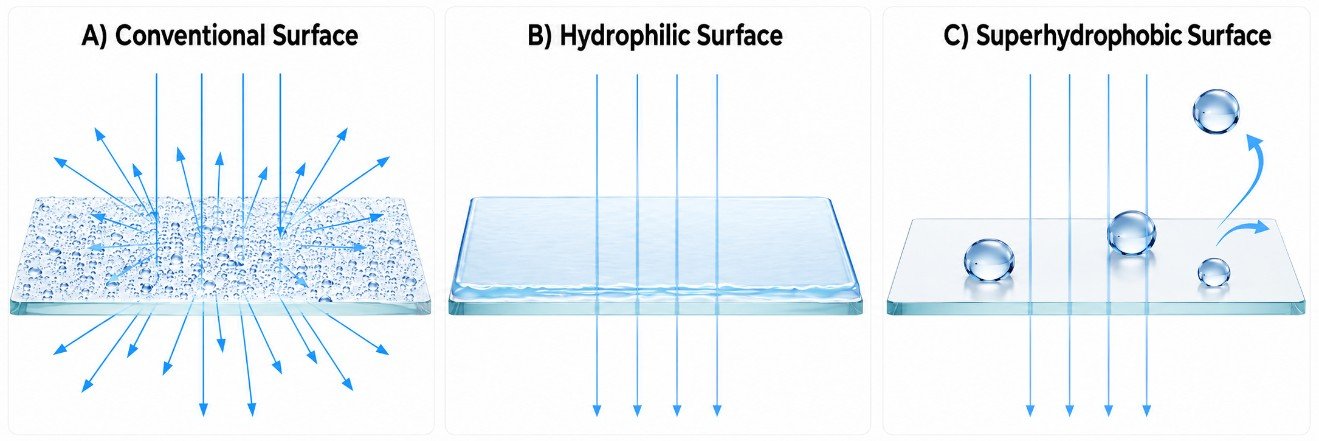
Figure 2: Illustrations of light passing through a conventional surface (A), a hydrophilic surface (B), and a superhydrophilic surface (C).
How Nanopatterns Change the Way Water Behaves
Whether water spreads across a surface or beads up depends partly on the surface chemistry of the material. But it also depends on something less obvious: the texture of the surface. This is where nanopatterns become important.
Imagine replacing a perfectly flat surface with one covered in tiny hills, valleys, pillars, or grooves. Even though those features may be too small to see, they can dramatically increase surface area and thus how a surface interacts with water.
On a hydrophilic surface like the one shown in Figure 3A, the added surface area strengthens the interaction with water. Because water is attracted to the surface, it is drawn into the tiny spaces between features, helping it spread rapidly and encouraging condensed droplets to merge into a thin, continuous layer rather than remain as individual droplets that scatter light.
On a hydrophobic surface, nanopatterns can have the opposite effect. Water may rest primarily on the tops of the features, with tiny pockets of air trapped underneath (Figure 3B). This reduces direct contact with the solid surface, allowing droplets to bead up and move more easily. On a superhydrophobic anti-fog surface, this behavior can help droplets roll, slide, or jump away before they accumulate.
In both cases, the nanopattern amplifies the underlying wetting behavior of the surface. By changing the size, shape, and spacing of the features, along with the surface chemistry, engineers can design surfaces that encourage water to either spread or bead up and leave.
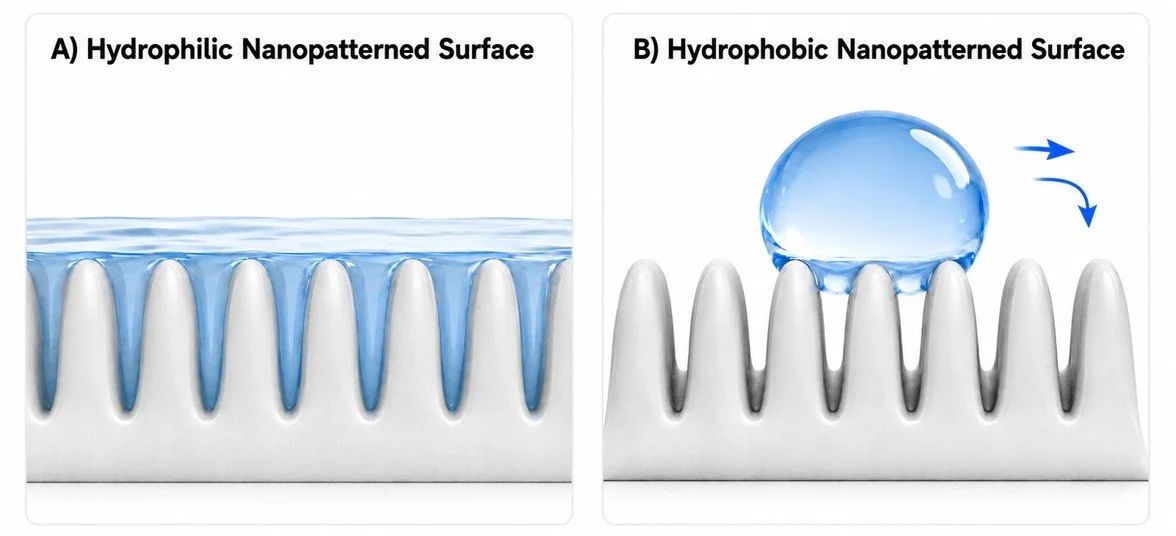
Figure 3: Illustrations water interacting with a hydrophilic nanopatterned surface (A) and a hydrophobic nanopatterned surface (B).
Anti-Fog Surfaces at Smart Material Solutions
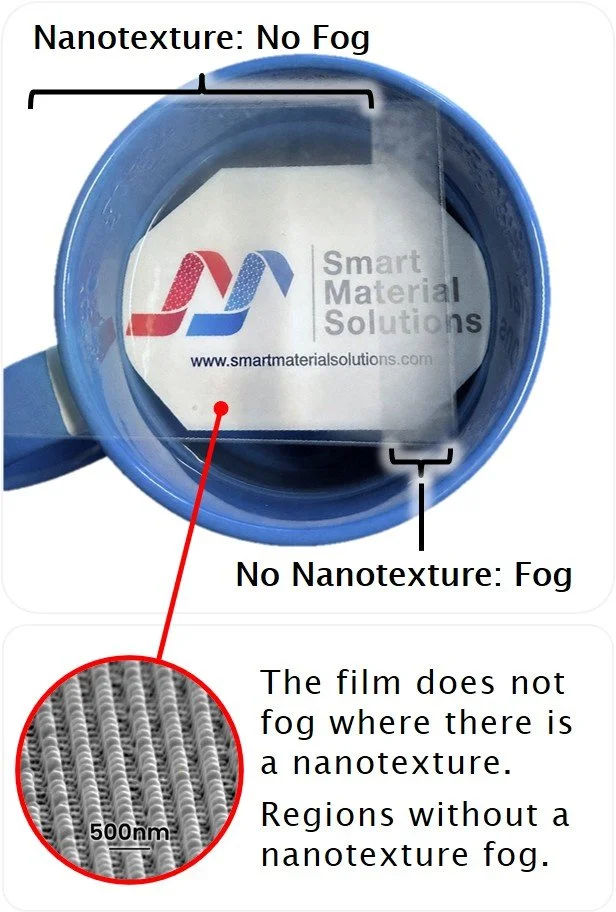
Figure 4: Anti-fog film created at SMS. The inset shows an electron microscopy image of the nanofeatures responsible for the anti-fog behavior. The smooth region on the right lacks these features and fogs under the same conditions.
At Smart Material Solutions (SMS), we are developing nanopatterned hydrophilic surfaces that reduce fogging by encouraging condensed water to spread.
Figure 4 demonstrates the effect by comparing patterned and unpatterned regions of the same material. The nanopatterned region on the left remains free of fog after exposure to steam, whereas the smooth region on the right is fogged up under the same conditions.
For most anti-fog applications, these surface textures are designed to be small enough that they don’t scatter light and are effectively invisible. But in applications such as packaging, where appearance and branding are important, the pattern can instead be designed to produce structural color. This makes it possible to incorporate vibrant logos or other targeted designs directly into the surface without dyes or pigments as shown in Figure 5, an approach that may be especially attractive for premium packaging and high-end brands.
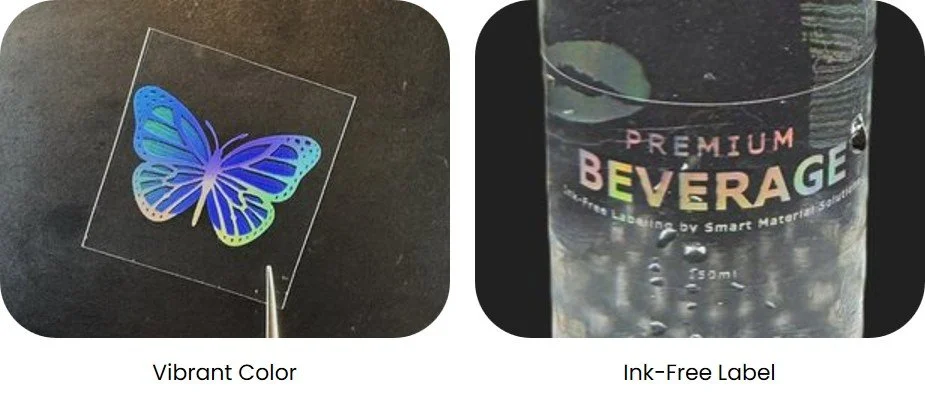
Figure 5: Examples of vibrant structural color and ink-free labeling that can strengthen branding without dyes or pigments.